Thursday, June 4, 2015

AMS Letter to Senators and Representatives

Last month the American Meteorological Society sent a letter to policy makers detailing the importance of funding geoscience research. Geosciences is the study of the earth system and includes weather, water, and climate. A link to the full letter can be found here. Here are some of the main points...
Sustained investment in all science is crucial to our societal and economic advancement. In particular, the geosciences contribute to jobs and innovation, create the foundation for our nation’s economic activity, reduce the impacts of natural hazards, support public health, and help us understand the world we live in and our connection to it.
The nation’s economy has prospered, with geosciences research providing our nation with the capability for efficient extraction of natural resources, reliable weather forecasts that enable safe air travel and efficient shipping, and the provision of clean drinking water. Our future depends on continuing this legacy of scientific inquiry and research in the geosciences. For example, improving our skill at seasonal forecasting will help energy companies to plan for and meet consumer demand, farmers to adjust for variations in seasonal rainfall, and cities to prepare for temperature extremes. Furthermore, investments in the geosciences are critical for saving lives and ensuring the safety of our nation. For example, our ability to predict the weather is based on geosciences research. A blizzard in 1888, known as the “Children’s Blizzard,” killed over 200 people because they were caught unawares. In contrast, the late January snowstorm that struck New York and New England with two to three feet of snow, high winds, and surging tides resulted in zero deaths because of the long lead time of the warnings. Similarly, deaths from tornadoes have greatly decreased because of significant improvements in scientific understanding, technology, and infrastructure. 
Steady and sustained geosciences funding will enable improved intensity forecasts of hurricanes threatening coastal regions, development of better strategies for communicating risk and uncertainty in forecasts, a decrease in the false alarm rate for tornados, and better prediction of heavy precipitation events like the one that caused the devastating floods along Colorado’s Front Range in 2013. Improved understanding of climate variability and change will help us avoid negative impacts and take advantage of emerging opportunities.
We urge you to continue our nation’s proud tradition of strong and sustained investments in the geosciences. In return, as scientists, we will continue to devote ourselves to improving the health and wellbeing of our great nation through transparent and meritorious science, advancing our understanding of Earth and our relationship with it.

Wednesday, June 3, 2015

Ozone Chasers

There weren't any storms to chase yesterday. Instead, we chased ozone pollution!

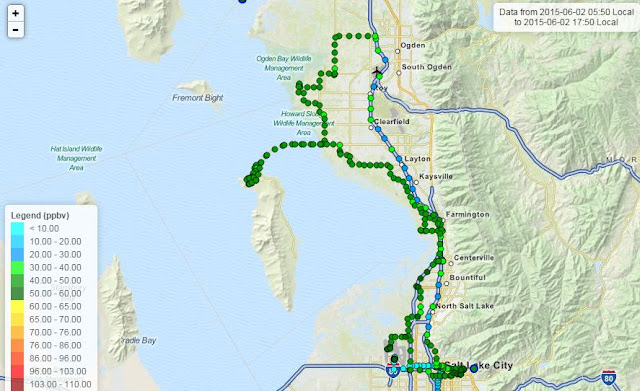
This summer our research group is involved in the Great Salt Lake Summer Ozone Study. The truck is equipped with and ozone monitor and a GPS.
Ozone Monitor
Truck with inlet tube sticking out the window and GPS on top of the truck.
Yesterday we we drove the truck from Ogden to Antelope Island and then to the international airport with an ozone monitor. We never encountered unhealthy levels of ozone, which is good. But ozone pollution in Salt Lake doesn't usually get to unhealthy levels until July because of it's dependence on sunlight. Later this summer we will be taking more observations. Yesterday's ozone chase was to test a route for the University of Utah Nerdmobile.

Of course, I couldn't leave Antelope Island without a bison selfie...

One of the projects I've worked on is providing HRRR sounding plots available for every hour of every day during the summer. I created this page for viewing these plots. These plots are from the HRRR analysis bufr soundings (downloaded from Penn State) and are created with this skew-T python package.

Monday, June 1, 2015

Back to the 90s

Yesterday was the first day this year we hit 90 degrees. In Spanish Fork we hit a high of 92. Here's a screenshot from my current conditions page from yesterday afternoon...

It was a hot one. We could easily make it to 90 degrees again today if the clouds don't get too thick. Here's the last 24 hour temperature in Spanish Fork. We're currently at 87 in Spanish Fork at 1:50 PM.


Today at work I'm working on processing HRRR data, so here's a screenshot of temperatures (in Celsius) in the western US for June 1st. I've roughly outlined where Utah is at...

Thursday, May 28, 2015

Rain --> Sun

Temperatures this month have been slightly cooler than usual, but not much. There has been more rain than your typical May. About half the days this month measuring rain at the airport. The amount of rain is about twice the normal amount for May.

Source: weather.gov/slc

Even right now there are severe thunderstorms passing through Box Elder county.

This weekend May will leave us warm and hot. Temperatures in northern Utah will be in the 80s. Take a look for yourself...this is the ridge forecasted to build over Utah on Sunday...
This is the NAM forecast for Sunday at noon. Perhaps it will be followed by a cool down when the trough over the ocean progresses inland.

Update: this morning I saw on twitter a few cool pictures from this storm. First, a picture taken Morgan County taken by Nicole McMillian.

And here's a look at quarterz sized hail out in the Uintah Basin!


Wednesday, May 27, 2015

Cool Clouds

Yes, clouds are pretty cool and hip, but they are literally cool. After all, a little cooling can create a new cloud if saturation is reached.

Today's first cool cloud: A lenticular cloud or cap cloud over Mount Timpanogos this morning.

The second cool cloud: Stratocumulus over President's Circle at the University of Utah

Third cool cloud: Some sort of orthographically lifted cloud yesterday in Spanish Fork.