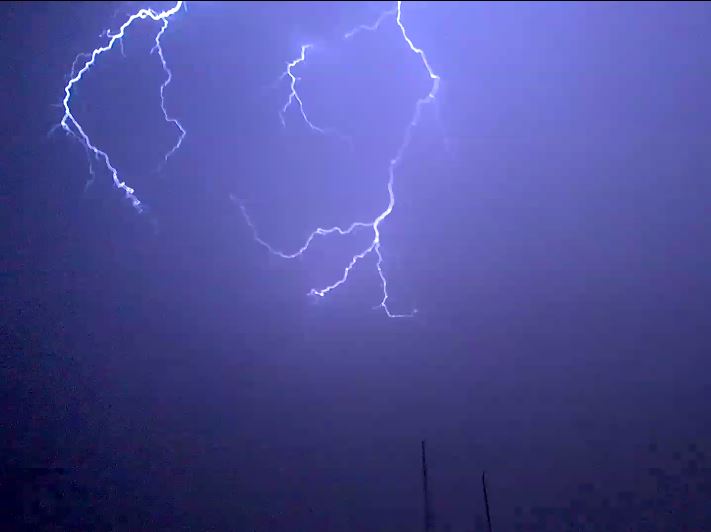
I was going to go mow the lawn, but then it started to rain. Then it started to rain harder, and I just had to check out the radar.
There is a nice convective thunderstorm cell moving north, northwest right over the river bottoms in Spanish Fork. The edge of the storm put 0.03 inches of rain at the house in just a few minutes (so far this month we've had 1.65 inches of rain in Spanish Fork, though I suspect that is an inaccurate measurement.)
 |
| source: Weather Underground |
Lightningmaps.org is a cool website where you can see the approximate location of the lightning strikes. These detectors detect both cloud-to-ground and cloud-to-cloud strikes. Each of the colored dots are lightning strikes. The yellow dots are the most recent strikes and the orange dots are older strikes.
When a lightning strike is detected a new yellow dot appears on the map with a red circle outline. A shaded and enlarging circle expands from the strike. This is the approximate location of where thunder is heard. We could hear the thunder from this particular strike (below) just a little before the thunder front on the map reached our house.
The storm has since moved north and more lightning is striking between Provo and Orem. Several people I've talked to said the thunder in Provo was pretty loud for a few moments.
Lightning detectors are scattered all around the world. When lightning strikes they emit a low frequency radio wave that can be detected by antennas states away from the storm. Below is a map from Lightningmaps.org that show lightning in the southeast being detected from stations all acros the country. Each yellow dot circled in red are the lightning strikes. The blue lines are drawn between the lightning strike and the detector the registered the strike. Each lightning event is measured by several stations so that the location of the lightning can be determined. A good Wikipedia article about lightning detection can be found
here.
 |
| source: lightningmaps.org |
Looks like the storm has passed and I can go mow the lawn now :)
------------------------------------------------------------------------
In other news, I got my exam results for a qualifying exam I took last week. I passed the exam "with distinction" meaning that I can now pursue a doctorate degree in Atmospheric Science.