Saturday, June 14, 2014

Cool Down

Looks like some cool weather will greet me as I return home...

Update: Flying over Utah Lake we experienced some turbulence. It must have been the front edge of the upper cold front. The plane dropped suddenly and everyone gasped and grabbed their arm rests. After a brief silence while the plane stabilized, the cabin erupted in laughter :) 

I missed the perfect opportunity to get a picture of radiation fog in Charlottesville. I'm kind of disappointed in myself. I guess I was too memorized looking at the fog. So here are some other pictures:

Our tiny plane in Charlotte, North Carolina.

North Carolina, lots of trees!

Nice stratus deck below the Appalachian Mountains.

No clouds, no trees...somewhere in New Mexico.

Mountains of Arizona.

Utah County, my home. Nice cumulus clouds developing over the mountain peaks.

On the ground. It is good to be home.

Wednesday, June 11, 2014

Severe Storms!

I did it! I survived my first Tornado Watch!
Source: weather.gov
Source: Wunderground.com/radar
Red shaded area indicates Tornado Watch area.
Ok, the watch was technically south of Charlottesville and the warning expired before the storm reached me. Oh well. I've experienced worse storms than this one anyways. 

The individual cells approaching Charlottesville diverged as they approached the city. On my walk back from class I felt a few sprinkles, but hardly enough to get the ground wet.


While Charlottesville dodged the storm, storm spotters reported strong winds and quarter sized hail near Lynchburg and Beckley, WV.

Radar is one of the most handy tools for nowcasting the weather (nowcasting describes the current weather and makes an extremely short weather forecast). The reason is because satellites don't take pictures often enough, and weather station data found on sites like MesoWest are not always "live" because of poor latency. Latency is the time delay between when an observation is made and when that observation is available for use. My weather station, for instance, sends an observation to MesoWest every 15 minutes, but it takes between 10 and 20 minutes before that observation appears in MesoWest's database.

Me and the storm splitting around Charlottesville.

The evening brought stratiform rain showers. CHAV2, south of Charlottesville, report 0.90 inches between 3 and 9 PM, and it's still coming down!
Source: Wunderground.com/radar
Source: Mesowest.utah.edu

UPDATE: June 12, 2014
Walking to class the morning after the storm I saw some of the aftermath--a lot of broken limbs and leaves on the ground. I heard from a friend that north of the university some larger limbs and also a tree had fallen down.
Add caption

Charlottesville shared this picture on their Facebook page:
Source: Experience Charlottesville

Sunday, June 8, 2014

Lightning Forecast

These fire flies are everywhere at night!
With one more week in Virginia that means I've got one week to experience a good, juicy southern thunderstorm. I've enjoyed the lightning bugs (I usually call them fire flies), but those small bugs aren't nearly as loud or dangerous as lightning.

Ingredients for a juicy lightning storm: moisture and lift. This week's forecast shows an approaching upper-level trough which will draw moisture from the Gulf and transport that moisture into Virginia by mid-week. Rain throughout the week is likely, but the best chance for a good lightning storm will be Wednesday and Thursday afternoon.

Below shows the June 8th 18z NAM forecast valid for Thursday 00z (Wednesday night).
source: weather.utah.edu
The NWS is calling for a likely chance of lightning. The Storm Prediction Center three day outlook show the potential for widespread thunderstorms the next few days. Below is shown the forecast for Storms will be scattered and largely affected by small scale topographic features and radiational heating, so we'll have to wait and see if one of the larger storm will cross over Charlottesville.

Update: June 11, 6:00 PM
The severe storm forecast has intensified since the Sunday forecast. Still a chance for storms on Thursday, but chances decrease as we move towards the weekend.

A camera in New York recently captured a tree being struck by lighting. Enjoy it!


Update July 1, 2014: Another exciting lightning video

Friday, June 6, 2014

Planet Gazing (kind of like star gazing)

I had to get my picture with the weather instruments, too.
On the top of "Mount" Jefferson sits the McCormick Observatory. (Mount is in quotes because I'm from Utah. It only took three minutes to walk to the top of this "mount.") This 26-inch telescope was built in 1884 and was the largest telescope in the United States (it had a twin at the U.S. Naval Observatory in Washington).


This evening my friends and I walked up the road from our dorms to the McCormick Observatory. On the first Friday of the month the Department of Astronomy at the University of Virginia host public viewings for anyone to look at planets and the moon through these powerful telescopes.

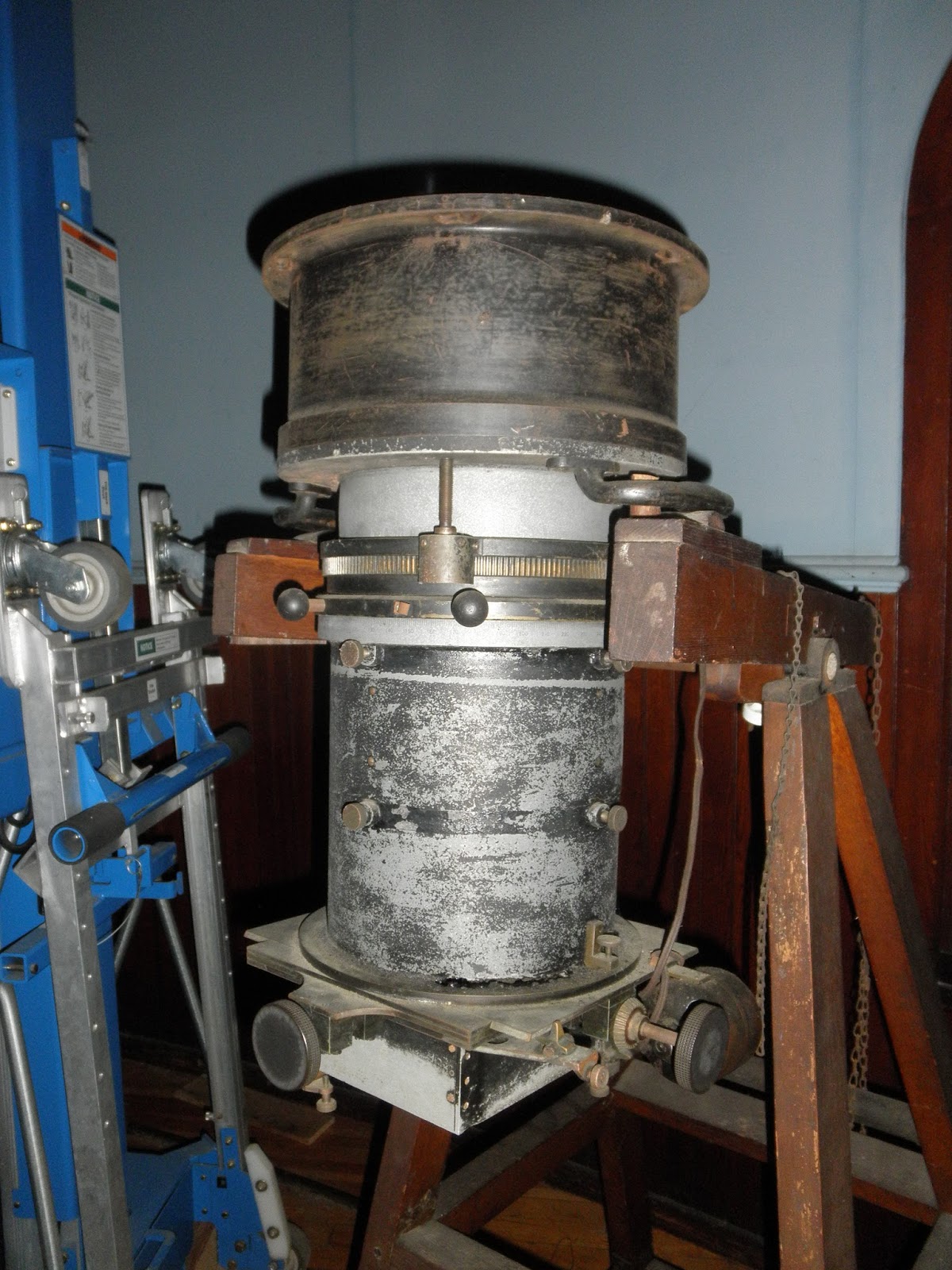
I was impressed with the mechanics of the building. Many of the moving parts in the dome are still operated by ropes and pulleys, though, some electric motors have been added.
     

Since Earth is spinning, the stars rise and set from east to west, just like our sun. After a few minutes of looking at a single star or planet the telescope's position has to be adjusted to account for the motion. The entire dome, telescope, and viewing platform can be moved when needed. In the short time waiting for my turn to look in the eye piece, the platform had moved twelve feet (past the door shown in the above picture). 


The image above and on the left shows some old clockwork used to track the motion of the stars or planets. The image on the right shows an attachment used to take pictures. This device would take pictures by exposing the film on glass plates. One major projects started in 1914 that used this telescope analysed the film to calculate the distance of nearby stars. 

Tonight the telescope was pointed at Mars. I can testify that that planet is red.


Outside on top of the "dog house" were two other telescopes--a 10-inch telescope pointed at Saturn and a 6-inch telescope pointed at the moon. I was surprised how crisp the images were. I've seen the moon many times, but I could see so much detail when looking through the telescope. When I first looked at Saturn I was expecting to see a bright spot in the view, but I was blown away with what I saw--rings, around a large planet. Yeah, everyone knows that Saturn has rings, but I actually saw the rings around Saturn!

I stole these pictures from the internet, but I wanted you to see what I saw through these telescopes:


Since this is a weather blog, I better say something about the weather. It was partly cloudy, as can be seen in the picture below. Not necessarily the best for star gazing, but the clouds were moving fast, so when they covered the planet we were looking at it was only a matter of a few seconds before they came into view again.

Wednesday, June 4, 2014

Atmospheric Optics

I missed it...everyone in Salt Lake is talking about the "rainbow cloud" observed this afternoon. This photo was shared by the National Weather Service:
source: weather.gov/slc
This is known as a circumhorizontal arc, a type of halo. According to the NWS these form "when the sun is high in the sky with cirrus clouds around, forming a halo. Becuase of the configure of cirrus clouds today, only part of the arc was visible."

Atmospheric optics is a unique area of study, but I don't particularly know of any practical uses for this knowledge. However, these are sights worth appreciation. People are most familiar with the rainbow caused by sunlight refracted by raindrops. Other optical phenomenon include sun dogs, ice halos, corona, glory, iridescent, and several others. You can play around this site for explanations and cool pictures of these occurances: http://www.atoptics.co.uk/

Last May I observed this beautiful halo out in the middle of Dugway. I'm quite proud of this picture:

If you look for them, you will notice these pretty optics more frequently, especially if you are wearing polarized sunglasses.

Meanwhile, I'm enjoying another lightning storm (this time from the comfort of my dorm room). It was a quick storm, but heard a few loud *CRACKS.*
source: wunderground.com/radar
In other news, we're going to Mars. NASA released this statement today:
“There is a consensus that our horizon goal should be a human mission to Mars and the stepping stone and pathways thrust of the NRC report complements NASA’s ongoing approach.  The key elements of that approach include the facilitation of commercial access to low-Earth orbit to sustain fundamental human health research and technology demonstrations aboard the International Space Station (ISS); the development and evolution of the Space Launch System (SLS) and Orion spacecraft to enable human exploration missions in cis-lunar and deep space, including to an asteroid; and the development of game-changing technologies for tomorrow’s missions, all leading the way on a path to Mars.
“NASA has made significant progress on many key elements that will be needed to reach Mars, and we continue on this path in collaboration with industry and other nations.  We intend to thoroughly review the report and all of its recommendations.”